Abstract
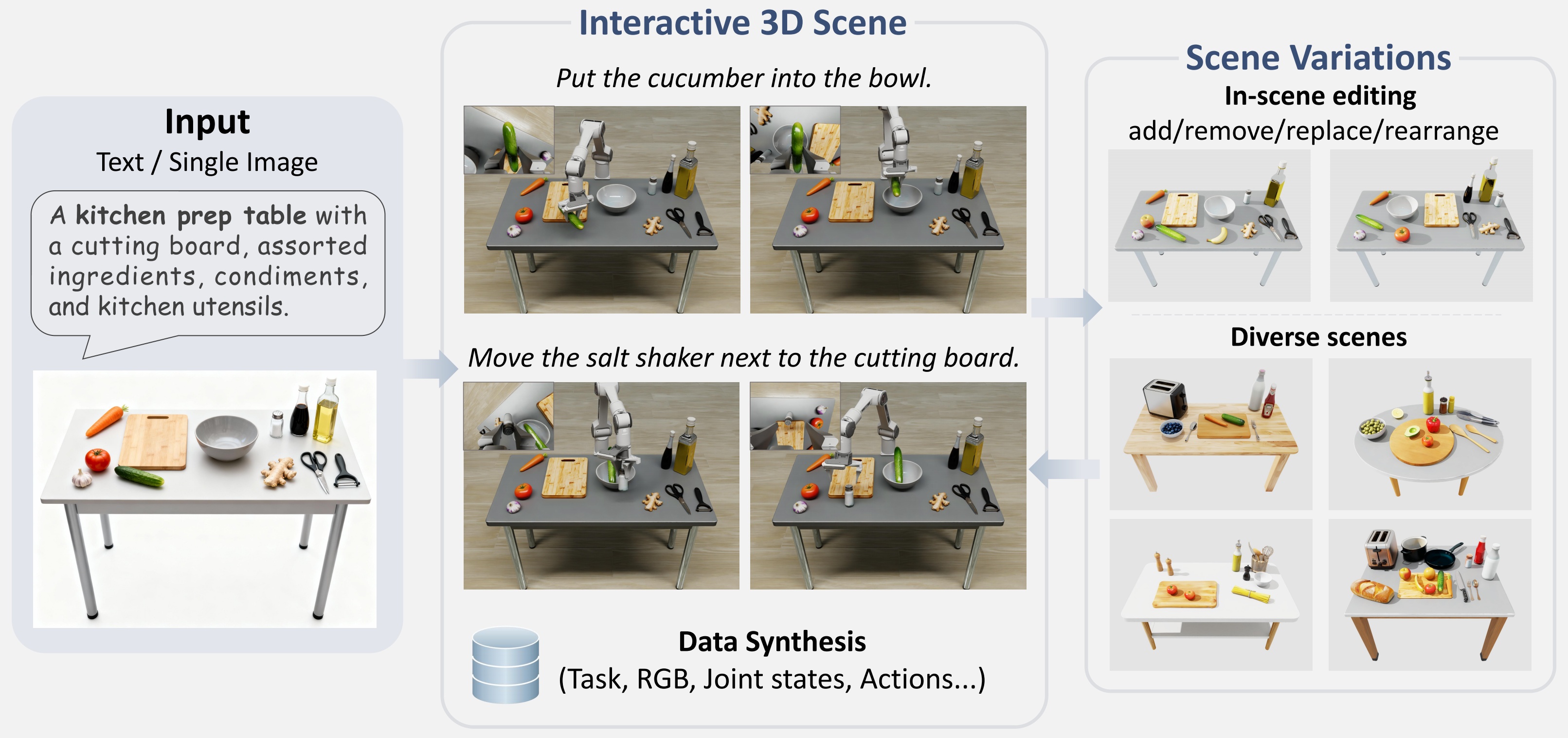
Simulation provides a low-cost, scalable pathway to large-scale robotic manipulation data collection. However, existing 3D scene generation methods can rarely be applied directly to manipulation data synthesis, as their generated scenes often lack instance-level interactivity and physical plausibility. Focusing on tabletop manipulation, we propose TabletopGen, a training-free and automated tabletop scene generation and interactive simulation engine. Starting from text or a single image, we first obtain independent 3D object models via generative instance extraction. Second, we introduce a novel pose and scale alignment approach that recovers a collision-free scene layout using a Differentiable Rotation Optimizer and a Top-View Spatial Alignment mechanism. Finally, we assemble the generated scene in a physics simulator with collision geometry, yielding a stable, interactable environment for synthesizing multimodal manipulation data. Extensive experiments and user studies demonstrate that TabletopGen achieves state-of-the-art performance in visual fidelity, layout accuracy, and physical plausibility. Furthermore, we validate the executability of the collected trajectories on a real robotic arm via zero-shot real-to-sim-to-real policy transfer, indicating that TabletopGen can serve as a reliable data engine for robotic manipulation data synthesis.

Interactive Scene Visualization
For smoother web visualization, we reduced the texture resolution of the models. Each scene may take about 10–20 seconds to load (depending on your network speed, possibly longer), so please be patient.
Select Scene
Manipulation Task Demo
Community

Scan to connect on WeChat and join our community for updates and discussions with the authors.
BibTeX
@article{wang2025tabletopgen,
  title={TabletopGen: Instance-Level Interactive 3D Tabletop Scene Generation from Text or Single Image},
  author={Wang, Ziqian and He, Yonghao and Yang, Licheng and Zou, Wei and Ma, Hongxuan and Liu, Liu and Sui, Wei and Guo, Yuxin and Su, Hu},
  journal={arXiv preprint arXiv:2512.01204},
  year={2025}
}